Stablecoins vs. Bitcoin Explained:Key Differences and Use Cases
Likewise, what exactly is the difference between cryptocurrencies, stablecoins and bitcoin? Why can Bitcoin go up 10% in a day and the stablecoin can hold $1 for the long term? This article delves deeper into the fundamental differences between stablecoins and bitcoin from value sources, price fluctuations, and application scenarios. Whether you're just starting out or an investor looking to optimize your asset allocation, you can learn about the positioning and complementarity of these two digital assets, and learn how to engage securely through ZONE Wallet, a Taiwanese regulatory compliance platform.
First, stablecoins and bitcoins: digital assets with the same origin but different fate
One word makes the difference clear
Bitcoinis a decentralized digital currency whose price is determined by market demand, fluctuates wildly and is considered “digital gold”;Stabilized currencyIt is a cryptocurrency with a price-anchored fiat currency (mainly the US dollar) that seeks “stability” and is considered a “digital dollar”.
Simple parables
Imagine you have two wallets:
- An outfitgold(Bitcoin) — High value, but price fluctuates day by day when selling, not suitable for buying bento directly
- An outfitThousand dollar banknotes(Stable Coin) — You can take it out at any time and it's worth $1,000 and it doesn't suddenly turn into 800 or 1,200
This is the most fundamental difference between the two.
Second, Core Difference Mapping Table|One Illustration to Understand Stable Currency vs Bitcoin
Third, the source of value is different: mathematical scarcity vs real asset reserve
The Value of Bitcoin: The Scarcity of Man-Made and Social Consensus
The value of Bitcoin does not depend on any tangible assets or sovereign credit, but is supported by three core elements:
1. Mathematically Determined Scarcity
The Bitcoin protocol sets a supply cap of 2,100 million coins and strengthens scarcity through a four-year “halving” mechanism — with each halving, miner's mining rewards are halved. The fourth half off, completed in April 2024, has reduced the block reward to 3.125 Bitcoins. THIS SHRINKAGE DESIGN CREATES SCARCITY ATTRIBUTES SIMILAR TO GOLD, BUT MORE VERIFIABLE THAN GOLD.
2. Decentralized network effects
According to Metcalf's law, the value of the network is proportional to the square of the number of users. The more Bitcoin holders, the higher its recognition as a store of value. More than 70% of Bitcoin is currently held by long-term accounts, which has the effect of making it the crypto world's fundamental store of value.
3. Community Consensus
Many investors believe that Bitcoin is “digital gold” and this collective perception is itself a source of value.
Value of stablecoin: 1:1 real asset reserve
The value of a stablecoin depends entirely on the sufficient reserve assets held by its issuer:
- Using USDC as an example, reserve status is verified monthly by an independent auditor to ensure that each circulating USDC has a corresponding $1 cash or highly liquid asset such as US Treasury bonds
- USDT issuer Tether holds approximately $1,160 billion in highly liquid assets such as US bonds as of 2025, accounting for 58% of global stablecoins reserves
- USAT is Tether's new stablecoin product redesigned from a regulatory level for the highly regulated US environment.
White version: 1 USDT in your hand with a really $1 bill (or USD equivalent) in the bank's trust account behind it. This is the root cause of stable currency “stability”.
⚠️ Important Risk Tips:
- USDT Reserve Transparency Dispute: Tether has been questioned over its failure to provide a full audit report and reached a settlement with the New York State Attorney General in 2021
- USDC DECOUPLING EVENT: USDC BRIEFLY FELL TO $0.87 DUE TO SILICON VALLEY BANK SHUTDOWN IN MARCH 2023
- Issuer risk: The stability of stablecoins is entirely dependent on issuer credit and may not be able to redeem 1:1 if the issuer goes bankrupt or has insufficient reserves
Fourth, the price fluctuation is different: sharp ups and downs vs wind movements
High volatility of Bitcoin
Bitcoin's price is driven by multiple factors such as market sentiment, macroeconomics, regulatory policies, and more:
- A one-day rise of more than 10% is normal
- Increase and decrease of more than 50% in one year
- Soared to $6.9 million from less than $3,000 in 2021, and fell back to $1.6 million a year later
This extreme volatility makes it difficult as a medium for everyday trading — you have a hard time accepting $100 worth of Bitcoin in the morning and only buying $90 items in the afternoon.
Low volatility of stablecoins
The design goal of stablecoins is “constant”:
- Annualized volatility of mainstream stablecoins is usually below 0.5%
- USDT CONTROLS PRICE VOLATILITY WITHIN ± 0.3% IN 2023 THROUGH A MARGIN MECHANISM
- Between 2024 and now, USDT has a volatility range of only $0.9975 to $1.0025
Why is it so stable? Because when the price deviates from $1, the evaders act immediately: buy when the price is below $1 and sell above $1, this market mechanism automatically pulls the price back to the anchor value.
Fifth, the application scenario is different: value storage vs trading medium
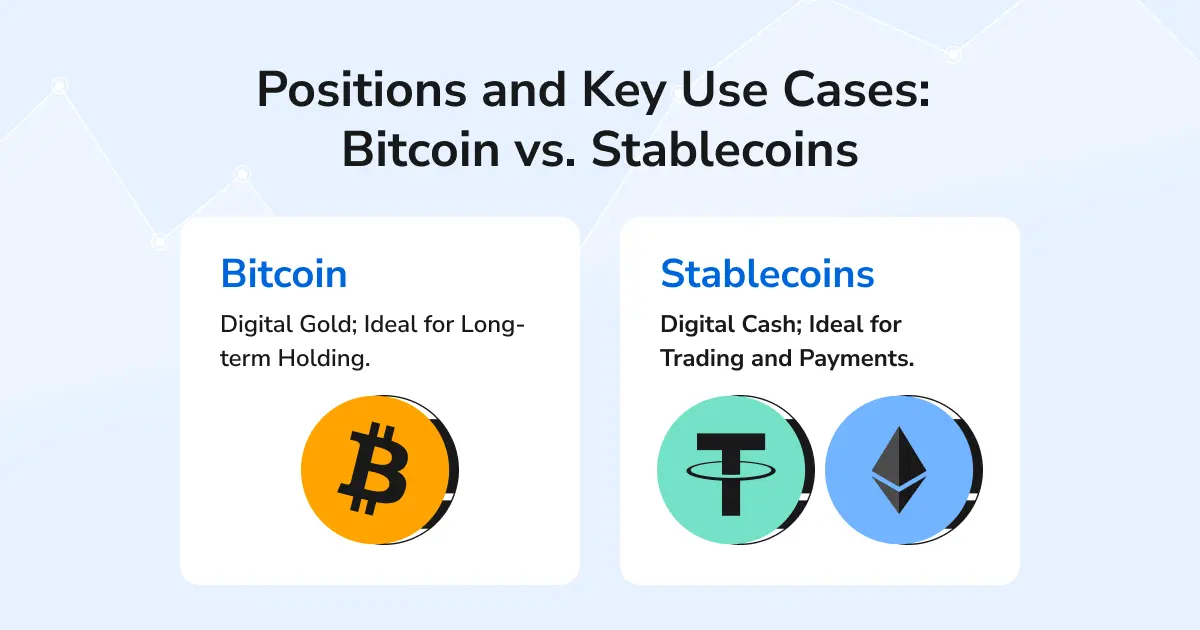
Bitcoin: Digital Gold for Long Term Holders
Bitcoin's positioning has evolved from the initial “peer-to-peer electronic cash” to a “store of value”:
- Organization Configuration: Investors are now more concerned about “holding Bitcoin” rather than using it to buy things, says Franklin Tamberton head of digital assets
- Digital Gold: As a tool to hedge traditional financial risks, Bitcoin is increasingly included in asset portfolios by large and small investors
- Borrowing Collateral: Bitcoin holders can borrow stablecoins as collateral to gain liquidity without selling assets
One Sentence Summary: Bitcoin is used to “put on hold”, not to “spend”.
Stablecoins: Digital Cash for Transactions and Payments
Stabilizer perfectly combines the efficiency of the blockchain with the stability of the franc to become a “universal medium of transaction” through a variety of scenarios throughout the chain:
1. Infrastructure of the Crypto Market
- More than 90% share in decentralized finance (DeFi) lending
- Preferred Settlement Tool for NFT and RWA (Real World Asset) Trading
- According to the XXX Research Institute's Q4 2024 report, the total settlement on the stablecoin chain exceeded $27 trillion in the year, reaching a volume that is on par with traditional card organizations
2. The Revolutionaries of Cross-Border Payments
- Traditional bank cross-border transfer fees are expensive (3-12%) and take 3-5 days
- Stable Currency Cross-Border Payments: Cost reduced to $0.01/item, reduced checkout time to 5 seconds
- USDT-Related Transactions Share Over 40% of Crypto Transactions in the Latin American Region in 2024
3. HAVENS OF HAVENS IN HYPER-INFLATED COUNTRIES
In countries where currencies are rapidly depreciating, such as Argentina, Nigeria, Turkey, etc., people use stablecoins as an asset protection tool:
- 34% of Turkey's population owns USDT
- Nigeria's foreign exchange receivable through stablecoin amounted to USD 200 billion in 2024, accounting for more than 30% of total foreign exchange
6. The fate of regulation is different: compliant pets vs regulatory edge
Stable Currency: Active Legislation by Countries
The stablecoin has become the focus of national regulation because of its potential impact on currency sovereignty and financial stability:
- USA: The GENIUS Act, 2025, establishes a federal regulatory framework for payments stablecoins
- EU: The Crypto Asset Markets Act (MiCA) imposes strict requirements on stablecoin issuance
- Hong Kong, China: Establishing a Hong Kong Dollar Stable Currency Regulatory Framework
Regulation has clearly opened the door to mainstream finance for stablecoins. Analysts point out that the stablecoin has instead gained political support by strengthening the dominance of the dollar — an advantage Bitcoin lacks.
Bitcoin: Regulatory Status Still Unclear
Bitcoin's regulatory fate is relatively complicated:
- Some countries are considered commodities (US CFTC stance)
- Considered a means of payment by some countries (El Salvador)
- Completely banned in some countries
This regulatory uncertainty limits Bitcoin's potential as an everyday means of payment.
7. COMPLEMENTARY RATHER THAN COMPETITIVE: SMART ASSET ALLOCATION STRATEGY
Roger Beston, Head of Digital Assets at Franklin Tambleton, points out that Bitcoin and stablecoins are not competitors, but play different roles in the digital financial systemComplementary Tools。
Layout Recommendations for Taiwan Investors
❌ Configuration is not recommended:
- COMPLETELY UNAWARE OF HOW CRYPTOCURRENCIES WORK
- Unable to bear any risk of loss of principal
- Requires short-term (within 3 months) active emergency funds
- Residents of countries affected by high inflation (stablecoins remain anchored to the US dollar and cannot counter the depreciation of the US dollar itself)
8. Frequently Asked Questions
Q1: Stabilized currency and Bitcoin, which one is safer?
A: The definition of “security” is different. Bitcoin's risk lies in price volatility, stablecoin's risk lies in issuer credit. From an asset protection perspective, stablecoin prices are more secure; from a long-term value-add perspective, Bitcoin's potential is greater.Distributed configuration is truly secure。
Q2: Will stablecoin crash like UST?
A: Need to distinguish between stablecoin types:
- ❌ UST (Terra): Algorithmic stablecoin crashes in May 2022 with investors losing more than $400 billion
- ⚠️ USDC: BRIEFLY UNHOOKED TO $0.87 DUE TO SILICON VALLEY BANK CLOSURE IN MARCH 2023, RESUMED AFTER 3 DAYS
- ⚠️ USDT: Reserve transparency controversy persists, but remains anchored to date
Conclusion: The risk of fiat mortgage-type is lower but not zero, and issuer credit and audit frequency should be evaluated when choosing.
Q3: Can Taiwanese buy stablecoins? Is it legal?
A: Yes. Taiwan citizens can buy and sell stablecoins through legal exchanges such as ZONE Wallet, which is a personal asset allocation and is not prohibited by law. Be careful, however, to choose the compliance platform for HKMA registration.
Q4: Where does the interest on stablecoins come from?
A: The stablecoin itself does not pay interest. However, you can use ZONE Wallet's “Easy Earn Banking Service” to lend the USDT you hold to the loan agreement and earn the interest paid by the borrower.
Conclusion: Recognize differences, smart configuration
Stabilizer vs Bitcoin, one stabilizing, one bullish; one is the blood of the transaction, the other is the store of value. Together, they form the infrastructure of the crypto economy and are indispensable.
For Taiwanese investors, understand the fundamental differences between the two to make the right asset allocation decisions for themselves:
- Want to be part of the digital gold story for the long term? Buy Bitcoin with a regular fixed amount
- Need an efficient cross-border payment or avoidance tool? Buy Stable Coins
- Want one-stop security management?ZONE Wallet makes it easy for you
👉 [Download ZONE Wallet Now], buy your first Bitcoin or stablecoin with NTD and experience the multiple applications of digital assets.
[download-app]
Disclaimer
This article is for educational and informational purposes only and does not constitute any form of investment advice, legal advice or tax advice. Cryptocurrencies and virtual assets are highly volatile investment vehicles whose prices can fluctuate dramatically and investors may face the risk of losing part or all of their principal.
While stablecoins aim for price stability, they may still face issuer credit risks, reserve asset opacity, liquidity overflows, regulatory policy changes and decoupling. Bitcoin price is influenced by a variety of factors, and past performance does not guarantee future results.
“Virtual assets are non-currency, high-risk transactions and investors should use caution,” the HKMA reminds.
ZONE Wallet is a legitimate provider of virtual asset services (pioneering digital technologies) that have been completed in compliance with the Financial Anti-Money Laundering Regulations. However, the platform services do not represent zero investment risk and do not guarantee profitability. Any investment decision shall be the sole responsibility of the investor.
The data and regulatory information referred to in this article have been tried to ensure accuracy to date, but relevant regulations and market conditions are subject to change at any time. Readers are advised to check with regulatory authorities or professionals for updates on their own.
Investing is risky. Please be careful before making a decision.
.jpg)