


Cryptocurrency and Blockchain: Reshaping the financial and trust architecture of the digital age
We are at the beginning of a financial revolution.
In 2009, the birth of Bitcoin not only created a new type of currency, but also opened up a whole new technical paradigm —Blockchain (Blockchain)。 This technology has challenged the basic logic of building the financial system for thousands of years: do we really need banks, governments, or any intermediary to guarantee the security of transactions?
Today, 15 years later, blockchain and cryptocurrencies have experimented from the edges and gradually moved towards the mainstream financial system. From Bitcoin spot ETF approvals, central banks developing digital currencies (CBDCs), to the thriving decentralized finance (DeFi) ecosystem,A new financial and trust architecture is taking shape。
This article will take you to a deeper understanding of how blockchain technology works, what it solves, how cryptocurrencies are changing the financial system, and what this revolution means for each of us.
First, the trust dilemma of traditional finance: why do we need blockchain?
Before discussing blockchain, first understand the core issues it is trying to solve:trusts。
Cost of trust in traditional financial systems
Imagine that you are sending $10 million to a friend far away in the United States. The transaction seems simple but involves a complex chain of trust behind it:
- You trust your bank to record balances correctly
- Your bank trusts the Central Bank's settlement system
- Central Bank Trusted International Clearing Institutions (such as SWIFT)
- IFIs trust each other country's banking system
- The other bank ends up sending the money to your friend.
Each loop of this chain of trust requires a cost:
- Time cost:It takes 2-5 working days to send money across the country
- Cost of money:The handling fee may be up to 5~ 10%
- Trust Costs: You must trust that each intermediary is honest and reliable
- Exclude Costs: The 17 billion people without bank accounts are excluded
The more fundamental issue is:These intermediary agencies wield enormous power。 They can freeze your account, reject your transactions, or even go bankrupt in a financial crisis (like the Lehman Brothers collapse in 2008).
Blockchain's revolutionary answer: technology replaces trust
Blockchain comes up with a radical idea:What if we don't need to trust any intermediary?
Through math, cryptography, and distributed networking, blockchain has created a”A trust mechanism that does not require trust(Trustless Trust)。 You don't need to trust the banks, you don't need to trust the government, you just need to trust “math and code.”
This sounds abstract, but the essence is simple:Allows everyone to maintain the same ledger so that no one can manipulate them on their own。
SECOND, BLOCKCHAIN TECHNOLOGY: REDEFINING THE MEANING OF “LEDGER”
How does blockchain work? Three Core Mechanisms
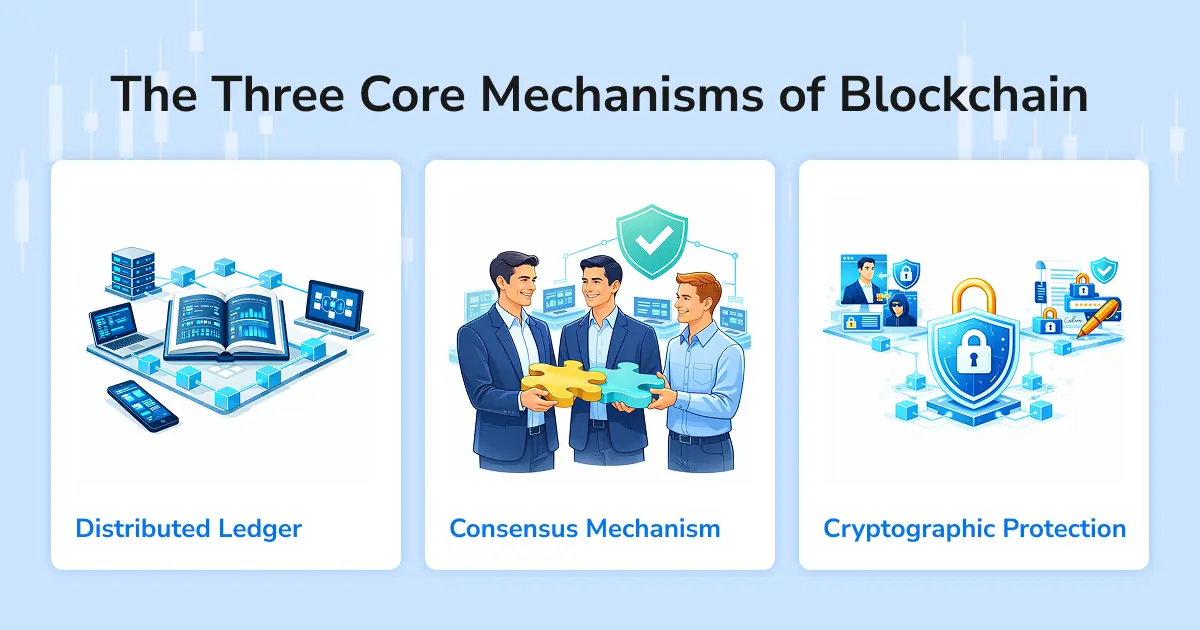
Three Core Mechanisms
① Distributed Ledger
Traditional bank ledgers are kept by banks alone, only they know who has how much money. Blockchain's ledger isPublic, distributed on thousands of computers worldwide。
- Every transaction is recorded in the Block
- Blocks are linked to a Chain in chronological order
- All participating nodes keep a complete copy
- Anyone can see the transaction history (but can't tell who's behind it)
② Consensus Mechanism
Since there is no central institution, how to ensure that everyone's recorded accounts are consistent? The answer is “consensus mechanism”.
- Workload Proof (PoW): Bitcoin Adoption, Miners Compete for Bookkeeping Through Arbitration
- Proof of Interest (PoS): Ethereum 2.0 Adoption, Stake Token Gets Bookkeeping
- Other Mechanisms: Various variants of DPoS, BFT, etc
Consensus mechanism ensures that even if some nodes are bad, the entire network can reach a consistent “truth”.
③ Cryptographic Security
Each block contains the “hash” of the previous block, forming a chain that is tied together in a ring.
- If someone tries to tamper with a past transaction, the hash value changes
- Hash values for all subsequent blocks will be invalid
- The manipulator has to recalculate the entire chain, which is almost impossible in arithmetic
These three mechanisms combine to create aUntampered, transparent, decentralized trust system。
The Three Revolutionary Characteristics of Blockchain
DecentralizationThere is no single agency controlling the network, and power is distributed to all participants.
ImmutabilityOnce a transaction is recorded and confirmed, it is almost impossible to reverse it.
Transparency is verifiableAll transactions are publicly viewable and anyone can verify authenticity.
Third, cryptocurrencies: the “native currency” on the blockchain
Blockchain technology is bornCryptocurrency (Cryptocurrency),A fully digitized, decentralized form of currency.
Bitcoin: the first successful decentralized currency
In 2008, Satoshi Nakamoto published the Bitcoin White Paper, which set out a vision:Create a peer-to-peer electronic cash system without the need for any intermediaries。
Bitcoin's revolution lies in:
- Total quantity fixed: 2,100 million pieces, does not grow, resists expansion
- Decentralized release: No central bank, acquired by miners through sheer force of effort
- Global Circulation: Can be used by anyone, not limited by region
- Anti-Censorship: NO ONE CAN FREEZE YOUR BITCOIN
After 15 years, Bitcoin has grown from a “geek toy” to an asset with a market capitalization of more than $1.8 trillion and is increasingly viewed by institutions as “digital gold.”
Ethereum: A Programmable Financial Infrastructure
If Bitcoin is “digital gold,” Ethereum is “digital financial infrastructure.”
In 2015, Vitalik Buterin launched Ethereum, introducingSmart ContractThe concept of an automatically executed code contract.
The Power of Smart Contracts:
Imagine that you are going to bet with a friend that it will rain tomorrow and bet $1,000. The traditional practice is to find a third-party custodian who is trusted by both parties. But smart contracts can do this:
- Both parties deposit $1,000 into the smart contract
- Contracts automatically scrape tomorrow's weather data from the Weather API
- If it rains, the contract automatically transfers $2,000 to the winner
- The entire process is fully automated without any intermediaries
Behind this simple example, there is a huge possibility:All transactions that require “trusted intermediaries” can be replaced by smart contracts。
Fourth, Decentralized Finance (DeFi): Rebuilding the Financial System
Based on smart contracts, a whole new financial ecosystem is being born on Ethereum:DeFi, Decentralized Finance。
How DeFi Is Reinventing Financial Services

Decentralized Lending
- Tradition: You go to the bank to apply for a loan, the bank reviews the credit, decides the interest rate
- DeFi: You mortgage cryptocurrencies on platforms such as Aave, Compound, and get a loan instantly, the interest rate is determined by market demand
DECENTRALIZED EXCHANGES (DEX)
- Tradition: You trade on a centralized exchange on Binance, Coinbase, etc., and the exchange holds your assets
- DeFi: You trade DEXs on Uniswap, SushiSwap, etc., the asset is always in your wallet, the exchange cannot be frozen
Stabilized Currency and Cross-Border Payments
- TRADITIONAL: TRANSFERRING MONEY ACROSS THE COUNTRY VIA SWIFT SYSTEM TAKES DAYS AND COSTS HIGH
- DeFi: Make global transfers in minutes with stablecoins like USDC, USDT, and more, with just a few dollars
Liquidity Mining and Gain Farms
- Traditional: Bank fixed deposit rate 1~ 2%
- DeFi: Provide liquidity to decentralized protocols, annualized returns can reach 5~ 20% (but with high risk)
Potential and Challenges of DeFi
Potential:
- Financial Services Open 24/7 Worldwide
- No Permission Required, Anyone Can Participate
- Transparency and verifiable transactions
- Automated execution to reduce human errors and corruption
Challenges:
- Smart Contracts May Have Vulnerabilities, Hackers Hacked
- Unclear regulation, unclear legal status
- Complex user experience, high threshold for beginners
- High price volatility, risk is difficult to manage
Despite the challenges, DeFi grew explosively during the “DeFi Summer” of 2020-2021, with a lock-in value (TVL) at one time exceeding $1,800 billion. This proves:Decentralized finance is not just a theory, but a feasible reality。
5. More applications of blockchain: the revolution of trust beyond finance
The potential of blockchain goes beyond finance. Any domain that requires “logging”, “authentication”, “trust” can be transformed by blockchain.
Supply Chain Management
Question: Consumers are unable to verify whether the source of the product is genuine (e.g. organic food, blood diamonds)
Blockchain Solutions:
- Each product is assigned a unique ID and linked at the time of production
- Every step from raw materials, production, transportation to sales is documented on the blockchain
- Consumers scan QR Code to see full traceability history
Actual case: Walmart uses IBM Food Trust Blockchain to track food supply chains, reducing traceability from 7 days to 2.2 seconds.
Digital Identity and Privacy
Question: Personal data exists on various platforms and is easily leaked and misused
Blockchain Solutions:
- Decentralized Identity (DID)
- Users own identity data, optionally authorize different services
- Verification process does not require full disclosure
Intellectual Property and the Creative Economy
Question: Creators find it difficult to prove originality, profits are extracted by the platform
Blockchain Solutions:
- NFTs (Adenaturized Tokens) Prove Ownership of Digital Creation
- Smart Contracts Automatically Allocate Royalties to Creators
- Creators connect directly with fans without intermediary platforms
Voting and Governance
Question: Election process is opaque, easy to cheat, difficult to monitor
Blockchain Solutions:
- EVERY BALLOT RECORDED ON BLOCKCHAIN
- Verifiable, Immutable, Anonymously Protected
- Instant invoicing, results are transparent
6. Challenges and the Future: The Next Step of the Blockchain Revolution
Despite its enormous potential, blockchain still faces many challenges:
Technical Challenges
Scalability
- Bitcoin can only process 7 transactions per second, Ethereum about 15
- In comparison, Visa processes 24,000 per second
- Layer 2 solutions such as Lightning Network, Optimism are improving
Energy Consumption
- PoW mechanism consumes amazing electricity, Bitcoin consumes the same amount of electricity per year as Argentina
- PoS mechanism significantly reduces energy consumption (99.95% reduction in energy consumption after Ethereum to PoS)
Regulatory Challenges
Legal status unclear
- Is cryptocurrency a currency, a security or a commodity? Different definitions by country
- Do DeFi protocols require a financial license? How are responsibilities assigned?
- The balance of privacy protection vs anti-money laundering (AML)
Tax Complexity
- How are cryptocurrency transactions taxed? The regulations vary widely from country to country
- Tax Tracking Difficulties for Cross-Border Transactions
Social Challenges
User Experience
- Private key management is complex, and it can never be recovered if you lose it.
- The interface is not friendly, the threshold for beginner learning is high
Fraud and Crime
- Anonymity abused for money laundering, ransomware
- Ponzi scam, fake project bar
Digital divide
- People without a network, without a smartphone are excluded
- Possibly widening the poverty gap
7. Conclusion: A revolution that has not yet ended
Cryptocurrency and Blockchain are not just a technological innovation, but a gameA Social Experiment on Trust, Power, and Freedom。
It challenges our basic assumptions about the financial system:
- Do we really need a bank?
- Should the government really control the money supply?
- Can intermediaries really protect us?
15 years of development proof: this is not utopian fantasy, butA viable alternative。 From Bitcoin's $1.8 trillion market capitalization, Ethereum's smart contract ecosystem, DeFi's worth of billions of lockdowns, to the development of digital currencies by various central banks,Blockchain is gradually reshaping the global financial architecture。
But the revolution is far from over. Technology still needs to mature, regulation remains clear, and the user experience needs improvement. In the next 10 years, we will witness:
- Deep fusion of blockchain and traditional finance
- Mass Launch of Central Bank Digital Currency (CBDC)
- The full eruption of the Web3 Ecosystem
- Next-generation decentralized apps (dApps) are transforming our daily lives
Now is the best time for everyone to understand this revolution. You don't need to be a tech expert, but you do need to understand: the world is changing, and you can choose to be a participant in this revolution or a bystander.
The future of trust may no longer require trusting anyone — just trust math, code, and a decentralized network. This sounds radical, but 15 years ago, the birth of Bitcoin was also considered crazy.
Today, we stand at a turning point in history. Are you ready?
Want to take the first step? Open an account with ZONE Wallet and buy stablecoins and Bitcoin with confidence!
[download-app] ZONE Wallet is a blockchain investment gateway designed for Taiwan users, complies with regulatory compliance in Taiwan x cutting-edge security technology x supports the buying and selling of new Taiwan currencies, is committed to driving the value of “every crypto transaction with peace of mind” so you can easily own your first cryptocurrency asset. Investing in virtual assets involves the risk of price volatility and liquidity. The above is for reference only and does not constitute financial advice. Assess your financial situation carefully before investing and be wary of fraud.
Disclaimer: This article is for educational and informational purposes only and does not constitute any investment advice. Cryptocurrencies and blockchain technologies are still evolving, involving multiple risks from technology, regulation, markets, and more. Please evaluate carefully and make an independent judgment.

.jpg)


